My Next Boat

My Legacy 32 has been the perfect boat for this trip, but I have something simpler in mind for my later life:
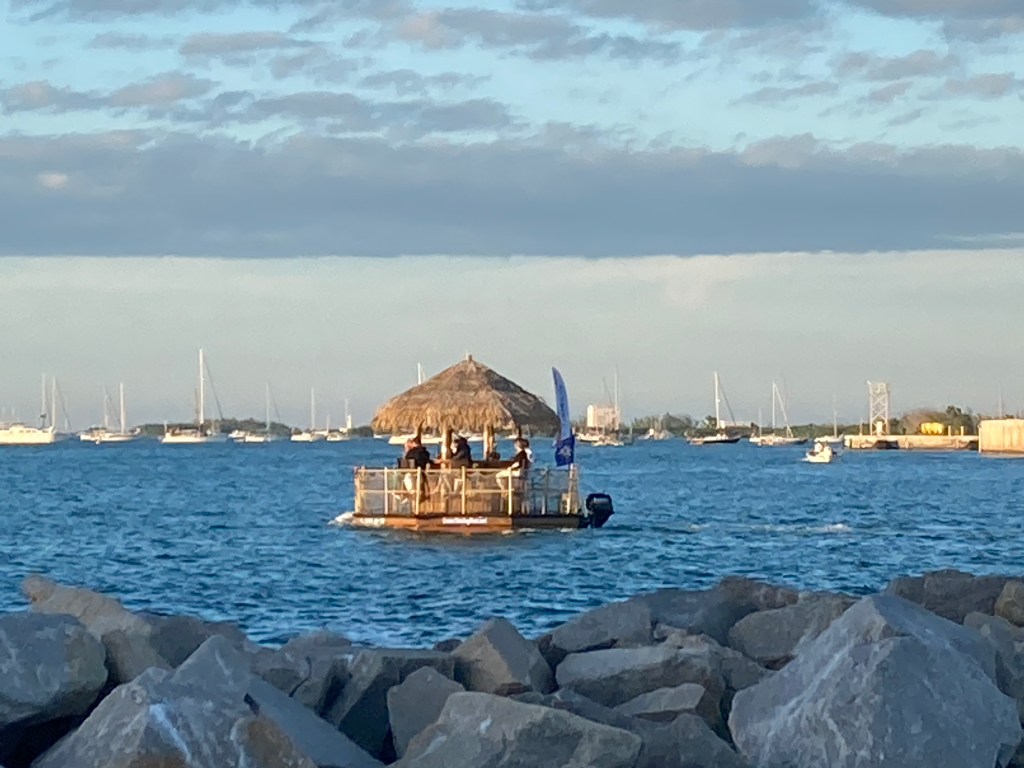
The photo above was snapped on a nice calm night, but I have seen this thing packed with tourists on choppy nights. No one in life jackets. Insane.

Tomorrow will be a busy day: after studying the wind forecasts, I’ve decided to leave on Thursday for our trip up Florida’s west coast. January 7th. So tomorrow is for final prep. Key West has been GREAT, but it’s time to move on.
Looe Key

Today we went snorkling at Looe Key, a coral reef located within the Florida Keys National Marine Sanctuary. It lies to the south of Big Pine Key; it is part of the reef system that defines the Hawk Channel, which runs down the outside of the Keys. There is not an actual Key per se: nothing above the water, but the reef is very close to the surface, and it’s clearly visible as you float on the surface. Of course, you see more if you free-dive down alongside the reef.

My dock-friend Jane DiPietro came, along with her son Steve, an active surfer and kite surfer. (The folks from Beach Haven.)

We chose a day with very moderate winds, but there was still a strong surge: swells rolling in from offshore. No bad once you were in the water, but the swim back to the boat (into the swells) promised to be exhausting, so we kept our dives rather short.

Nevertheless, it was a living coral reef: good to see one again, and sad to realize that it is something our grandchildren may never see. We saw sea fans, brain coral, and a great variety of fish, turtles and dolphins. It was a real treat; I had not been diving in many years.

A nice ride out and back, although Guinness got seasick while we were at anchor in the swells.

Lethargy

It’s defined as  a “state of prolonged torpor or inactivity, inertness of body or mind,” 

It’s definitely settling in…I should be cleaning and oiling the teak decks… I should be dropping my laundry off at the Dockmaster’s office…

Instead, I am simply relaxing. Or maybe learning to relax for the first time in my life. Key West is working its magic on me.

So – with apologies to Keats for the uneven meter – here’s an Ode to Indolence that I composed this afternoon:

One day as I lay idle and serene,

Indolence subsumed my blissful scene.

I thought of tasks that I had yet to do,

But quickly took a more lethargic view.

In fact, it’s just too hard to lift my pen;

I doubt that I will ever strive again.

********************************************

It’s a good thing we’re scheduled to leave here on the 8th. This could become a permanent condition.

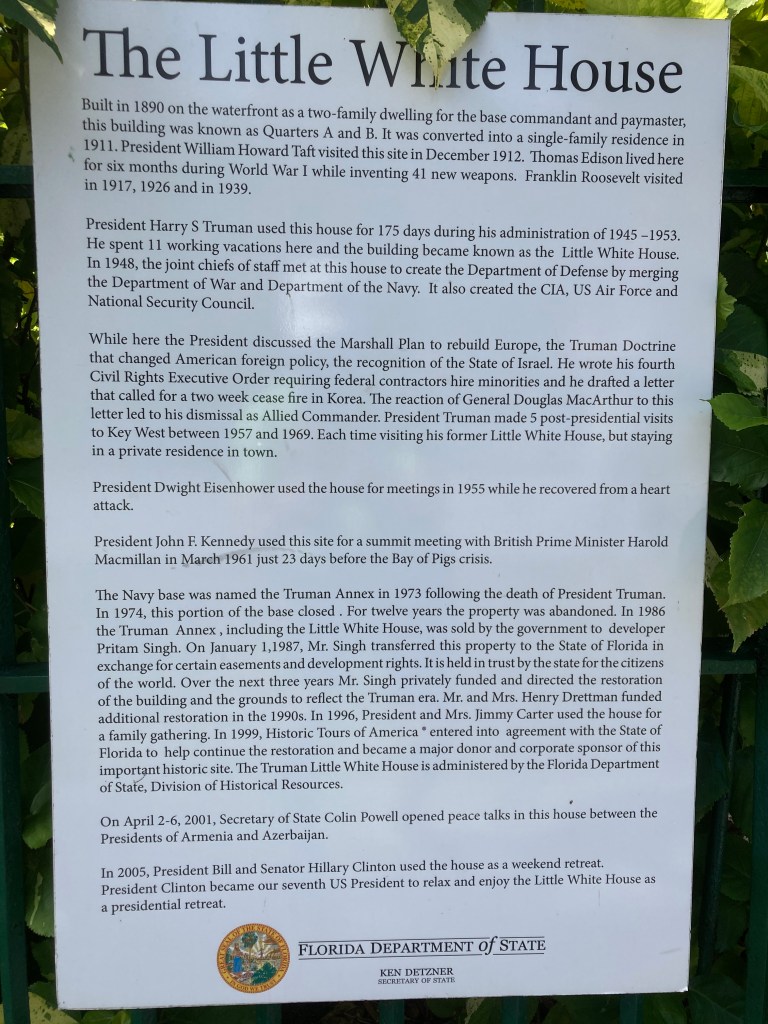
Truman’s Little White House

Yesterday, we visited the building known as Truman’s Little White House. Guinness wore his Service Animal vest and was very well behaved. Here’s all you need to know:

The house itself is a very simple, unpretentious two-story building. I liked it, in part because it is a snapshot of a simpler time. No TV, no air conditioning, no water view. Entertainment involved whiskey, golf, or poker. There is a great life-size cutout of HST in a Hawaiian shirt, holding a golf club. Sorry, we weren’t allowed to take photos. The house is beautifully decorated; very calm and relaxing.

Interesting footnote: Truman’s ratings fell to 22% after he fired General McArthur- the lowest of any sitting president. But history has amended that: he has now been ranked #5 of all Presidents by CBS News. A farm boy from Missouri, who never wanted to be President. He assumed the office upon Roosevelt’s death in 1945.

  1. Abraham Lincoln (1861-1865) Lincoln’s first-place standing in the C-SPAN survey is due to high ratings across the board, but historians hold him in highest esteem for crisis leadership.
  2. George Washington (1789-1797) The nation’s first president ranked above all others for moral authority, economic management, and overall performance within the context of his times.
  3. Franklin D. Roosevelt (1933-1945) Historians laud Franklin D. Roosevelt for his skills at public persuasion, ranking him first among all presidents in that category.
  4. Theodore “Teddy” Roosevelt (1901-1909) Theodore Roosevelt ranked highly for public persuasion. Just 42 when he became the youngest president in the nation’s history, he had the excitement and energy to convince Congress to pass progressive reforms and a strong foreign policy — exemplified by his motto, “Speak softly and carry a big stick.”

Truman wins praise from historians for his crisis leadership. 

After V-E Day, when Japan refused to surrender, he ordered atomic bombs to be dropped on Hiroshima and Nagasaki, finally ending World War II in the Pacific. Shortly thereafter, Truman watched the signing of the charter of the United Nations, established to preserve peace.