
Pilots file Flight Plans. Sailors file Float Plans. Here’s the first segment of ours, built in Excel.
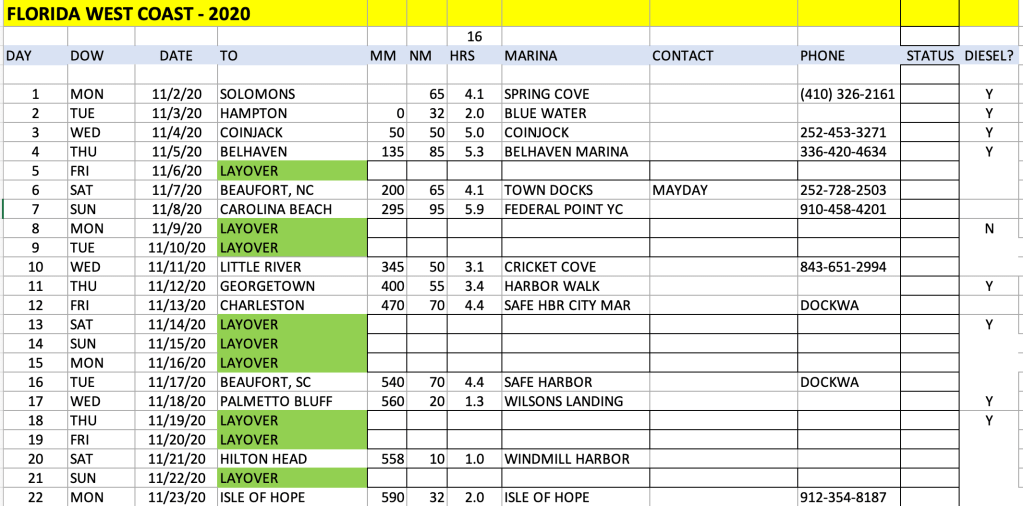
Here’s how we built it:
- It begins in early November, because our insurance policy will not allow us to be south of Cape Hatteras until the hurricane season ends on November. 1st.
- We began planning each day’s leg by looking ahead 50-80 miles to see what marinas were available.
- Sometimes the legs were shorter; sometimes longer.
- Then we built in our layover days: at least one per week, allowing for weather.
- More layover days for fun stops like Charleston
MM stands for Mile Marker. The ICW portion begins at MM 0 in Portsmouth (Hampton), VA and ends at MM 1245 in Key West.
NM stands for Nautical Miles traveled that day. This is the critical variable for planning purposes.
HRS stands for Running Time in hours at an average of 16 knots.
Based on the Float Plan, I expect the trip to take 33 days elapsed time, allowing for layover days for weather and R&R. We’ll leave 11/2 and arrive in Key West December 4th.
It’s 26 actual travel days. Not particularly daunting… just 26 days when – every day – something can possibly go wrong. Ha Ha.
Each horizontal row represents a single day-trip. Green cells are lay-by days for visiting or for rest or as a bad-weather provision. There are also yellow cells indicate opportunities to leave the ICW and travel “outside” for a speedier passage. These opportunities exist because there are inlets that are safe to navigate (many are not), but the decision to go outside is entirely weather-dependent.
For that matter, the entire schedule is entirely weather-dependent. We will take whatever steps are prudent to avoid bad weather. Rain isn’t a problem, but rough sea conditions may cause delays, particularly in places like Albemarle Sound. The Sound is only 14 miles across (less than an hour for Freedom), but it can become very choppy because it is uniformly shallow, and wind from almost any quarter can create rough, confused seas. (per Waterway Guide). In particular, if the wind is as little as 15 knots out of the west, it can make for a very unpleasant crossing. For that reason, it may be necessary to lay over an extra day or two in Coinjock to wait for better weather. We may even have to wait up in Hampton if the boats ahead of us are holding up in Coinjock. If the marinas are full, we need them to move out so that we can move in.
In that case, the entire schedule may slide. We built the same flexibility into our plans when we brought the boat down from Nantucket: Hurricane Isaias was threatening the Northeast, so we just holed up in a protected marina and let it pass. We were able to make up the lost day by skipping one scheduled stop. Something similar will undoubtedly happen on this trip.
It is critically important to make decisions according to the weather, not the calendar. It doesn’t really matter when we arrive at each intermediate stop. Reservations can usually be tweaked with no problem, or an alternative can be found. Safety and comfort come first.
 Rod & Guinness' Amazing Adventures